

Effect of Body Condition Score at Calving on Reproductive Performance in Nili Ravi Buffaloes
byAbstract
The current study aimed to investigate the effect of body condition score (BCS) at calving on post-calving reproductive performance in Nili Ravi buffaloes. The study was conducted at the Livestock Experiment Station, Hasalpur, Pakistan. Thirty-six buffaloes were selected approximately 40 days before the expected date of calving and randomly divided into three study groups (12 buffaloes/group) based on their BCS. The BCS was assigned on a scale of 1–5 with 0.25 increment and the BCS groups were categorized as; 1) low, buffaloes with BCS ≤ 3.0; 2) medium, buffaloes with BCS 3.25 to 3.5; and 3) high, buffaloes with BCS ≥ 3.75. The feeding allowance was given according to the requirements of individual animals to maintain their BCS till calving. Post-calving feeding was done according to their production level. The enrolled buffaloes were followed till 300 d of lactation. The results revealed that the body condition score (BCS) at calving significantly influenced reproductive performance in buffaloes. Buffaloes in the medium BCS group had 101 fewer days to first estrus, 1.5 fewer services per conception, and 87 fewer days open compared to the low BCS group (p < 0.05). However, the performance of the medium BCS group was only numerically better compared to the high BCS group for these reproductive measures (p > 0.05). The results suggested better reproductive performance in buffaloes with a medium BCS at calving (3.25-3.5) compared to those with low and high BCS.
Keywords: Calving BCS; dairy buffaloes; reproductive performance; services per conception
1. Introduction
Reproductive efficiency is a major determinant of dairy farm profitability. Reproductively efficient herds have cows with improved resumption of ovarian function, estrus detection, and establishment and maintenance of pregnancy. Body condition score (BCS) at calving influences the resumption of ovarian function and conception rate in dairy cows [1].
Energy balance during early lactation has been associated with reproductive performance [2]. Many researchers proposed that controlling BCS at calving could minimize negative energy balance and improve reproductive performance in dairy cows [3]. Various studies have shown positive[4], negative [5], or no [6] association between BCS at calving and the probability of conceiving at first AI. High BCS in early days of lactation was associated with more days to first estrus with delayed ovarian activity [7]. Lopez-Gatius et al. [8] reported that low BCS at parturition affects pregnancy rate at the first AI. Low postpartum BCS was genetically correlated with a longer interval to commencement of luteal activity [9], a prolonged calving interval [10], and more days to first service and days open [11]. High BCS at calving also affects pregnancy rate at first AI [12]. A study in dairy buffaloes showed improvement in reproductive performance up to BCS 3.99 on a scale of 1-5 [13]. The buffaloes with higher BCS had delayed resumption of ovarian activity and more days to first estrous [13]. Further studies on buffaloes to investigate the association of fat reserves at calving with reproductive performance would help better understand the issue.
The objective of the current study was to investigate the association of BCS at calving with reproductive performance of dairy buffaloes. More specifically to evaluate the association of BCS at calving with post-calving BCS and body weight changes, and their relationship with ovarian function, days open, and pregnancy rate in Nili Ravi buffaloes.
2. Materials and Methods
2.1. Study Site, Animals, Housing, and Management
The trial was conducted at the Livestock Experiment Station, Chak Katora, Hasal-pure, Pakistan (29°42'43.9"N 72°33'19.1"E; elevation = 139 m). Thirty-six (36) buffaloes were selected in the study approximately 40 days before expected calving and were kept in a naturally ventilated shed with access to a loafing area. The dry cow feed consisted of a total mixed ration (TMR) containing 60% corn silage, 8% wheat straw, and 32% concentrate mix on a dry matter (DM) basis to maintain their respective BCS up to calving. The lactation diet consisted of lactation TMR with 40% corn silage, 5% wheat straw, and 55% concentrate mix. Buffaloes received similar diets to allow ad-libitum feed intake throughout the trail (with 10% refusals). The animals were provided with water troughs for free access to fresh water.
2.2. Study Design
The enrolled buffaloes were randomly divided into three study groups, each with an equal number of animals (12 animals per group). The study groups were categorized according to their BCS as follows: 1) low, buffaloes with BCS ≤ 3.0; 2) medium, buffaloes with BCS 3.25 to 3.5; and 3) high, buffaloes with BCS ≥ 3.75 at the time of enrollment. The BCS was assessed using a scale of 1 to 5, with increments of 0.25, as validated in the study by Magsi et al. [14]. The concentrate allowance was adjusted according to the requirements of each animal to maintain its BCS until calving. Post-calving feeding was done according to their production level. The buffaloes were followed till 300 d of lactation.
2.3. Reproductive Measures
Reproductive measures included days to first estrus, days to first service, days open, interval from first artificial insemination (AI) to conception, and pregnancy rate. Estrus detection was performed twice daily, in the morning and evening, using a teaser bull. All inseminations were conducted through AI. The voluntary waiting period was set at 45 days according to the farm protocol. Post-calving BCS change was also monitored to assess the energy status of buffaloes.
2.4. Statistical Analysis
All the statistical procedures were performed using SAS (SAS for Academics, SAS Institute Inc., Cary, NC). Proc GLM was applied to evaluate the association of reproductive measures with calving BCS. Post-calving BCS changes were subjected to repeated measures ANOVA using a mixed procedure of SAS where BCS at calving was taken as fixed effects and buffalo as the random effects in the model. The significance was declared at p ≤ 0.05.
3. Results and Discussion
The results are summarized in Table 1. The body condition score (BCS) at calving significantly influenced the days to first estrus and first service in buffaloes (p< 0.001; Table 1). The days to first estrus were 152, 51, and 69 in the low, medium, and high-BCS groups, respectively (Table 1). The low BCS group had significantly more days to first estrus and first service than the medium and high-BCS groups (Table 1).
These findings align with Dechow et al. [11], who reported a genetic correlation between low postpartum BCS and increased days to first estrus. Similarly, Anitha et al. [13] found that dairy buffaloes with a BCS ≥ 4 at calving experienced a longer interval to first estrus. In agreement with our study, Gobikrushanth et al. [15] observed that cows with greater BCS loss after calving took longer to reach first estrus. Additionally, Van Straten et al. [16] showed that cows with a medium BCS at calving had a shorter interval to first estrus compared to those with low or high BCS.
The BCS at calving influenced days open in a similar pattern to that of days to first service in buffaloes (p< 0.001; Table 1). Days open were 252, 165, and 186 in the low, medium, and high-BCS groups, respectively. Consistent with our findings, Ruegg et al. [17] found that cows with a BCS < 3.5 at parturition had fewer days open than cows with a BCS ≥ 3.5. Similarly, cows with a BCS ≥ 3.75 took 21 more days to conceive as compared to cows having BCS 2.75 to 3.5 [18]. Likewise, Stefanska et al. [3] found that cows with a BCS > 3.75 took 40 more days to conceive compared to cows with a relatively medium BCS (3.25-3.5).
The number of services per conception was 3.3, 1.8, and 2.6 in the low, medium, and high BCS groups, respectively (Table 1). The difference between the medium and low BCS groups was significant (p < 0.002; Table 1), while the high and low BCS groups had a similar number of services per conception (Table 1). These findings are consistent with those of Gobikrushanth et al. [15], who found that cows with a high BCS at calving required more services per conception. Similarly, Anitha et al. [13] reported that buffaloes with a medium BCS required fewer services per conception compared to those with low and high BCS.
The first artificial insemination (AI) to conception interval was 106, 54, and 90 days for the low, medium, and high-BCS groups, respectively (p < 0.001; Table 1). The medium BCS group had a significantly lower first AI to conception interval compared to the low and high BCS groups (Table 1).
| Items | BCS groups 1 | SEM | p-Values | ||
|---|---|---|---|---|---|
| Low | Medium | High | |||
| Days to first estrous | 152 a | 51 b | 69 b | 9.2 | <0.001 |
| Days to first AI service | 152 | 61 | 69 | 7.9 | <0.001 |
| Number of services per conception | 3.3 | 1.8 | 2.6 | 0.46 | <0.002 |
| Days open | 252 | 165 | 186 | 14.5 | <0.001 |
| First AI to conception interval | 106 | 54 | 90 | 7.9 | <0.001 |
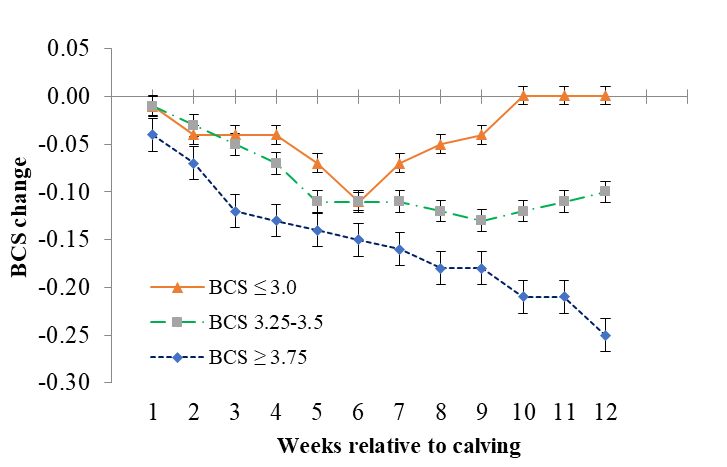
The post-calving change in BCS of buffaloes is presented in Figure 1. During the first 12 weeks after calving, the BCS continued to decrease for the high BCS group, while it stopped decreasing by week 6 for the low BCS group. The high BCS group in our study experienced a more significant decrease in BCS post-calving, indicating a greater loss of fat. This may explain the slightly delayed resumption of ovarian activity and poorer reproductive performance in our study compared to the medium BCS group. In agreement with current findings, Hoedemaker et al. [19] reported that cows losing more than 0.25 BCS had more days to first estrous. Further studies incorporating more physiological variables would help to understand better the relationship between BCS at calving, post-calving BCS change, and reproductive performance.
4. Conclusions
In conclusion, this study revealed that BCS at calving has an impact on post-calving reproductive performance in buffaloes. The buffaloes with 3.25 to 3.5; BCS scale 1–5 with 0.25 increment at calving performed better concerning days to first estrus, number of services per conception, and days open.
References
- Santos, S.A.; Abreu, U.G.; Souza, G.D.; Catto, J.B. Body condition score, weight variation and reproductive performance of beef cows in rangelands from the Pantanal region. Rev. Bras. Zootecn. 2009, 38(2): 354–60. [Google Scholar] [CrossRef]
- Chandra, G.; Aggarwal, A.; Singh, A.K.; Kumar, M.; Kushwaha, R.; Singh, A.; Singh, Y.K. Negative energy balance and re-production: A review. Agric. Rev. 2011, 32(4):246–254. [Google Scholar]
- Stefańska, B.; Nowak, W.; Pruszyńska-Oszmałek, E.; Mikuła, R.; Stanisławski, D.; Kasprowicz-Potocka, M.; Frankiewicz, A.; Maćkowiak, P. The effect of body condition score on the biochemical blood indices and reproductive performance of dairy cows. Ann. Anim. Sci. 2016, 16(1): 129–143. [Google Scholar] [CrossRef]
- Roche, J.R.; Macdonald, K.A.; Burke, C.R.; Lee, J.M.; Berry, D.P. Associations among body condition score, body weight, and reproductive performance in seasonal-calving dairy cattle. J. Dairy Sci. 2007, 90(1): 376–391. [Google Scholar] [CrossRef]
- Heuer, C.; Schukken, Y.H.; Dobbelaar, P. Postpartum body condition score and results from the first test day milk as predic-tors of disease, fertility, yield, and culling in commercial dairy herds. J. Dairy Sci. 1999, 82(2): 295–304. [Google Scholar] [CrossRef]
- Gillund, P.; Reksen, O.; Gröhn, Y.T.; Karlberg, K. Body condition related to ketosis and reproductive performance in Norwe-gian dairy cows. J. Dairy Sci. 2001, 84(6): 1390–1396. [Google Scholar] [CrossRef]
- Chagas, L.M.; Bass, J.J.; Blache, D.; Burke, C.R.; Kay, J.K.; Lindsay, D.R.; Lucy, M.C.; Martin, G.B.; Meier, S.; Rhodes, F.M.; Roche, J.R. Invited review: New perspectives on the roles of nutrition and metabolic priorities in the subfertility of high-producing dairy cows. J. Dairy Sci. 2007, 90(9): 4022–4032. [Google Scholar] [CrossRef]
- López-Gatius, F.; Yániz, J.; Madriles-Helm, D. Effects of body condition score and score change on the reproductive perfor-mance of dairy cows: a meta-analysis. Theriogenology 2003, 59(3-4): 801–812. [Google Scholar] [CrossRef]
- Royal, M.D.; Pryce, J.E.; Woolliams, J.A.; Flint, A.P.F. The genetic relationship between commencement of luteal activity and calving interval, body condition score, production, and linear type traits in Holstein-Friesian dairy cattle. J. Dairy Sci. 2002, 85(11): 3071–3080. [Google Scholar] [CrossRef]
- Pryce, J.E.; Coffey, M.P.; Brotherstone S. The genetic relationship between calving interval, body condition score and linear type and management traits in registered Holsteins. J. Dairy Sci. 2000, 83: 2664–2671. [Google Scholar] [CrossRef]
- Dechow, C.D.; Rogers, G.W.; Klei, L.; Lawlor, T.J. Heritability and correlations for body condition score and dairy form with-in and across lactation and age. J. Dairy Sci. 2004, 87(3): 717–728. [Google Scholar] [CrossRef]
- Roche, J.R.; Meier, S.; Heiser, A.; Mitchell, M.D.; Walker, C.G.; Crookenden, M.A.; Riboni, M.V.; Loor, J.J.; Kay, J.K. Effects of precalving body condition score and prepartum feeding level on production, reproduction, and health parameters in pasture-based transition dairy cows. J. Dairy Sci. 2015, 98(10): 7164–7182. [Google Scholar] [CrossRef]
- Anitha, A.; Rao, K.S.; Suresh, J.; Moorthy, P.S.; Reddy, Y.K. A body condition score (BCS) system in Murrah buffaloes. Buffa-lo Bull. 2011, 30(1): 79–96. [Google Scholar]
- Magsi, S.H.; Ahmad, N.; Rashid, M.A.; Bah, M.; Akhter, M.; Shahid, M.Q. Validation of a body condition scoring system in Nili Ravi dairy buffaloes (Bubalus bubalis): inter-and intra-assessor variability. J. Dairy Res. 2022, 89(4): 382–385. [Google Scholar] [CrossRef]
- Gobikrushanth, M.; Macmillan, K.; Behrouzi, A.; Hoff, B.; Colazo, M.G. The factors associated with postpartum body condi-tion score change and its relationship with serum analytes, milk production and reproductive performance in dairy cows. Livest. Sci. 2019, 228: 151–160. [Google Scholar] [CrossRef]
- Van Straten, M.; Shpigel, N.Y.; Friger, M. Associations among patterns in daily body weight, body condition scoring, and reproductive performance in high-producing dairy cows. J. Dairy Sci. 2009, 92(9): 4375–4385. [Google Scholar] [CrossRef]
- Ruegg, P.L.; Goodger, W.J.; Holmberg, C.A.; Weaver, L.D.; Huffman, E.M. Relation among body condition score, serum urea nitrogen and cholesterol concentrations, and reproductive performance in high-producing Holstein dairy cows in early lacta-tion. Am. J. Vet. Res. 1992, 53(1): 10–14. [Google Scholar] [CrossRef]
- Wathes, D.C.; Fenwick, M.; Cheng, Z.; Bourne, N.; Llewellyn, S.; Morris, D.G.; Kenny, D.; Murphy, J.; Fitzpatrick, R. Influ-ence of negative energy balance on cyclicity and fertility in the high producing dairy cow. Theriogenology, 2007, 68: S232–S241. [Google Scholar] [CrossRef]
- Hoedemaker, M.; Prange, D.; Gundelach, Y. Body condition change ante‐and postpartum, health and reproductive perfor-mance in German Holstein cows. Reprod. Domest. Anim. 2009, 44(2), 167–173. [Google Scholar] [CrossRef]
Copyright: © 2024 by the authors.
License: This article is published under the Creative Commons Attribution 4.0 International.CC BY 4.0


Publisher: Insights Academic Publishing (IAP), Lahore, Pakistan.