
Keywords
heat stress
season
broiler productivity index
How to Cite
Abstract
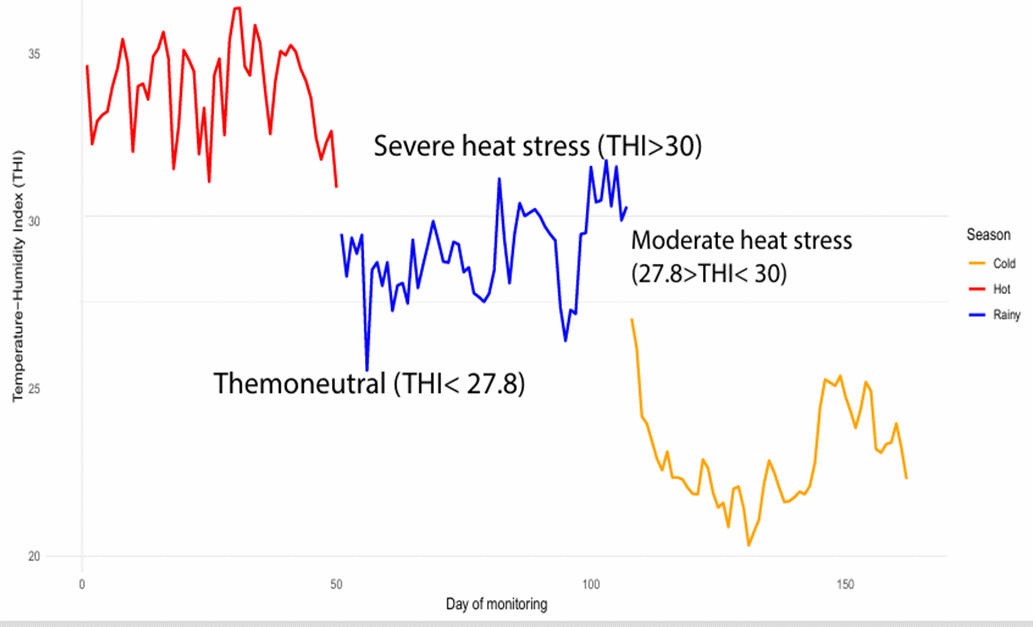
This objective of the study was to investigate the effects of season and energy levels on the broiler productivity index (BPI) in the semi-arid environment. The study was conducted in three different seasons (hot, rainy and cold seasons). A total of 2,025 boiler chickens comprising three strains (Arbor Acre, Marshall and Hubbard) were used. Of this, 675 were used per season, with 225 birds from each strain. The birds were fed diets containing three energy levels: low (LE), medium (ME), and high (HE). Temperature-humidity index (THI) of the seasons was computed to characterize the thermal comfort of the chickens across the seasons. Results indicated that the chickens were reared under severe heat stress (THI > 30), moderate heat stress (THI 27.8–28.8), and thermo-neutral conditions (THI < 27.8) during the hot, rainy, and cold seasons, respectively. Additionally, energy level and season significantly affected the BPI of the chickens (p < 0.05). Birds fed the LE diet had a higher BPI than those fed the other energy levels. Furthermore, birds reared during the cold season exhibited a higher BPI than those reared in the other seasons. Therefore, feeding the LE diet improved the BPI of birds across all seasons.

This work is licensed under a Creative Commons Attribution 4.0 International License.
Copyright (c) 2025 Aliyu Sa'adu, Aminu Abubakar, Adamu Mani Isa, Nafi’u Lawal, Bello Bunza Abubakar, Bello Musa Bodinga (Author)